#WeAreGreekWarriors
From the Greek Revolution to Today:
The Power of the Heroines of 1821 Lives in Every Woman




LASKARINA BOUBOULINA, c. 1771 – 1825
“Mother of The Greek Revolution”
Laskarina Bouboulina was a Greek naval commander and one of the most recognizable heroines of the Greek War of Independence (1821–1829). Born in 1771 in Constantinople and raised on the island of Spetses, she defied the strict gender expectations of her time to become a leader in battle and a symbol of freedom.
Bouboulina inherited great wealth and used it to build and equip a fleet of ships, including her flagship, the Agamemnon, and personally led Spetsiot sailors in naval campaigns. On March 13, 1821, she raised one of the first revolutionary flags on Spetses, signaling the island’s revolt against Ottoman rule. She then sailed with eight ships to join the blockade and siege of Nafplion, a key strategic fortress in the struggle for Greek freedom.
Bouboulina gained the respect and admiration of her fellow revolutionaries. They called her “Kapetanissa,” a title honoring her courage, leadership, and naval skill. She was one of only a few women who joined the secret revolutionary society Filiki Etaireia (Society of Friends), which was founded in 1814 in Odessa, whose purpose was to overthrow Ottoman rule in Greece and establish an independent Greek State.
After her death in 1825, Tsar Alexander I of Russia posthumously promoted her to the rank of Admiral, making her one of the earliest recorded women to hold such a naval title. In 2018, the Greek state recognized her contributions by awarding her the honorary rank of Rear Admiral in the Hellenic Navy.
Laskarina Bouboulina’s legacy endures as a powerful example of women’s leadership, courage, and sacrifice in the fight for freedom.
RALLOU KARATZA, c. 1799–1870
“Pioneer of Greek Theater, Translator, Actress, Director, Princess”
Rallou Karatza was a significant figure in the cultural and intellectual history of modern Greece. Born into a prominent Phanariote family, she held the title of princess while making lasting contributions to the performing arts during the early nineteenth century.
At a time when women’s participation in public artistic life was extremely limited, Karatza played a leading role in the development of Greek theater. She worked as a translator, actress, and theatrical director, organizing and guiding stage productions that advanced the use of the Greek language and introduced audiences to dramatic works shaped by European literary traditions.
Karatza’s theatrical endeavors extended beyond artistic expression. Through performance and translation, she contributed to the cultivation of cultural awareness and national identity during the period surrounding the Greek War of Independence. Her work supported the broader intellectual movement that sought to preserve Greek heritage and promote ideals of education and self-determination.
Rallou Karatza’s career reflects a rare example of female leadership in the arts during her era. Her legacy endures as that of a pioneering cultural figure who expanded the role of women in theater and helped shape the foundations of modern Greek cultural life.
MANTO MAVROGENOUS, c. 1796–1848
“Artistocrat, Commander, Strategist, Financier”
Manto Mavrogenous was a distinguished leader and patriot whose courage and vision made her one of the most influential figures of the Greek War of Independence. Born into a wealthy and well-educated family in Trieste, she devoted her resources, intellect, and personal authority to the cause of Greek liberation from Ottoman rule.
A skilled organizer and strategist, Mavrogenous used her family’s wealth to equip troops, fund naval operations, and provide critical support to fighters on the front lines. Historical accounts note that she also financed and personally commanded naval vessels, directing ships in military operations in the Aegean Sea in support of the revolutionary cause. She played a key role in mobilizing military forces on the Aegean islands, inspiring volunteers to join the struggle, and working tirelessly to sustain the revolutionary effort through diplomacy and resource coordination.
Mavrogenous was not only a financier of the revolution but also a forceful advocate for Greek sovereignty on the international stage. She corresponded with foreign leaders and urged support for the Greek cause, arguing that freedom should be defended by the Greeks themselves and highlighting the human cost of war. Her leadership combined patriotism, intellect, and heartfelt commitment to liberty.
In a period when women’s participation in public affairs was severely constrained, Manto Mavrogenous emerged as a rare example of female authority in both military and political spheres. Her legacy remains a testament to resolute leadership, national pride, and the indispensable role of women in the struggle for independence.
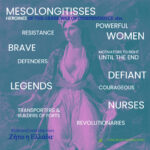
MESOLONGITISSES, c. 1821–1826
“Women of Messolonghi”
The Mesolongitisses were the women of Messolonghi whose courage and sacrifice became emblematic of the city’s resistance during the Greek War of Independence. Throughout the prolonged siege of Messolonghi, they played an essential role in sustaining the city’s defense under extreme hardship.
These women actively supported the war effort by fortifying the city’s walls, transporting food supplies, caring for the wounded, and providing logistical support to the fighters. They gathered enemy cannonballs for reuse and transported other essential war supplies. Their unwavering commitment to defending their city placed them alongside the troops and the civilians in the fight for freedom.
In April 1826, during the historic Exodus of Messolonghi, the women marched alongside men and children in a desperate attempt to break through Ottoman forces after months of starvation and siege. Most were killed during the assault, and many chose death over capture, committing suicide to avoid enslavement.
The collective sacrifice of the Messolongitisses stands as one of the most profound acts of resistance in modern Greek history and remains a lasting symbol of courage, dignity, and devotion to liberty.
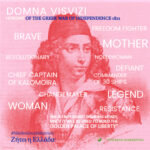
DOMNA VISVIZI, c. 1783–1850
“Bouboulina of Thrace: Naval Leader of the Greek War of Independence”
Domna Visvizi was a prominent naval figure in the Greek War of Independence, whose leadership and personal sacrifice made her among the most significant women of the revolution. Born in Ainos, in Eastern Thrace, she came from a prosperous maritime family and devoted her resources and resolve to the struggle against Ottoman rule.
At the outbreak of the revolution, Visvizi actively supported naval operations by arming and supplying her family’s ship, Kalomoira. Following the death of her husband in battle, she assumed full command of the vessel, leading its crew herself and continuing its participation in military operations. Under her direction, the ship served in blockades, supply missions, and engagements that supported revolutionary forces in the northern Aegean.
Visvizi expended nearly her entire fortune in service of the cause, financing naval campaigns, maintaining her crew, and sustaining prolonged operations at sea. Her actions reflected a steadfast belief that personal wealth was secondary to national freedom, a conviction captured in her words: “We do not regret spending money since it will be used to build the golden palace of liberty.”
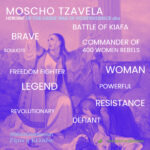
MOSCHO TZAVELA, c. 1760–1803
“Commander and Symbol of Resistance”
Moscho Tzavela was a Souliote woman whose life and actions represented resistance against Ottoman authority in the decades preceding the Greek War of Independence. Born into the influential Tzavelas family of Souli, she lived during a period of continuous conflict, when the mountainous communities of Epirus fought to preserve their autonomy and way of life.
Tzavela is remembered for her active participation in the struggles of the Souliotes, particularly during confrontations with the forces of Ali Pasha of Ioannina. Historical tradition and later literary accounts describe her courage, leadership, and determination in moments of extreme danger, including episodes in which she chose defiance over submission. Her actions came to represent the collective spirit of the Souliote resistance.
Although she lived before the formal outbreak of the Greek Revolution in 1821, Tzavela’s story became firmly established in Greek national memory. Writers and historians of the nineteenth century frequently invoked her example as a precursor to the revolutionary ideals of sacrifice, honor, and freedom.
Moscho Tzavela’s legacy remains as a symbol of early female resistance and moral courage. Her life reflects the crucial role women played in sustaining the spirit of independence that would later culminate in the Greek War of Independence.
WOMEN OF SOULI, c.1803
“The Dance of Zalongo”
The Women of Souli occupy a central place in the history of resistance in the years preceding the Greek War of Independence. Members of the Souliote communities of Epirus lived in a region marked by prolonged conflict as local populations sought to preserve their autonomy against the expanding power of Ottoman authority under Ali Pasha of Ioannina.
In 1803, following the collapse of Souli’s defenses, a group of Souliote women found themselves surrounded and facing imminent capture. According to historical tradition, they chose death over enslavement. At the site of Zalongo, these women, holding their children, are said to have joined hands, sung, and moved rhythmically toward the edge of the cliff before leaping to their deaths. This act became known as the “Dance of Zalongo.”
The event has been preserved through oral tradition, song, literature, and later historical accounts, becoming one of the most enduring symbols of collective sacrifice in Greek national memory. The women’s actions came to represent an unwavering commitment to dignity, freedom, and communal honor.
Today, the Monument of Zalongo stands as a memorial to the Women of Souli, commemorating their final act of defiance. Their legacy endures as a powerful testament to the role of women in resistance movements and the enduring human struggle for liberty.